How to Make a Dubai Apartment Balcony Usable All Year
The Direct Answer
A Dubai apartment balcony can be useful throughout the year if it is easy to set up on a good day and easy to pack away when conditions turn. Start with a seat on the sheltered side, surfaces that take a quick wipe and a clear path through the door. Handle insects at the doorway and privacy where people actually sit. Before fixing anything to the railing, frame or outside wall, ask building management what the property allows. On a dusty or windy day, a usable balcony is often one that can be closed down without a job left outside.
What can a resident change, and what belongs to the building?
The outside edge of a balcony is a poor place to guess where private space ends. In Law No. (6) of 2019 Concerning Ownership of Jointly Owned Real Property in the Emirate of Dubai, published on the Dubai Legislation Portal, Article 7(a)(1) lists façades among the building’s Common Parts. Article 9(a)(5) includes a balcony allocated to an owner among the components of the unit, unless the Site Plan says otherwise. So a balcony can be part of an apartment while the façade it meets is still a shared part of the property.
Article 39(a) requires approval from the Master Developer, the Dubai Land Department and the competent authority for substantial alterations or modifications to the structure or external appearance of a unit, or to any part of the jointly owned property. The article does not classify every screen or fitting. Building management is a practical first contact for identifying what the proposed fitting would touch and which approvals apply. A building manager’s reply should not be treated as a substitute for any approval the law requires.
The distinction matters even when the job looks small from inside. A screen could occupy only the doorway but still call for a fixing in a part of the frame the resident is not allowed to change. A panel clipped to a railing could change what the balcony looks like from across the courtyard. Owners and tenants can both start with the same question: which surface, if any, can the resident alter?
| Change | Where it happens | First step |
|---|---|---|
| Move a chair towards a sheltered wall | Within the seating area | Try the position with the door fully open and the path clear |
| Draw an existing indoor blind | Inside the apartment | Check the view into the room after dark |
| Add a screen at the balcony door | At the opening and its frame | Ask management which mounting surfaces are permitted |
| Fit a panel to the railing or outside wall | At the building’s exterior | Get the applicable rules and approval route in writing before ordering |
What makes the balcony worth opening in every season?
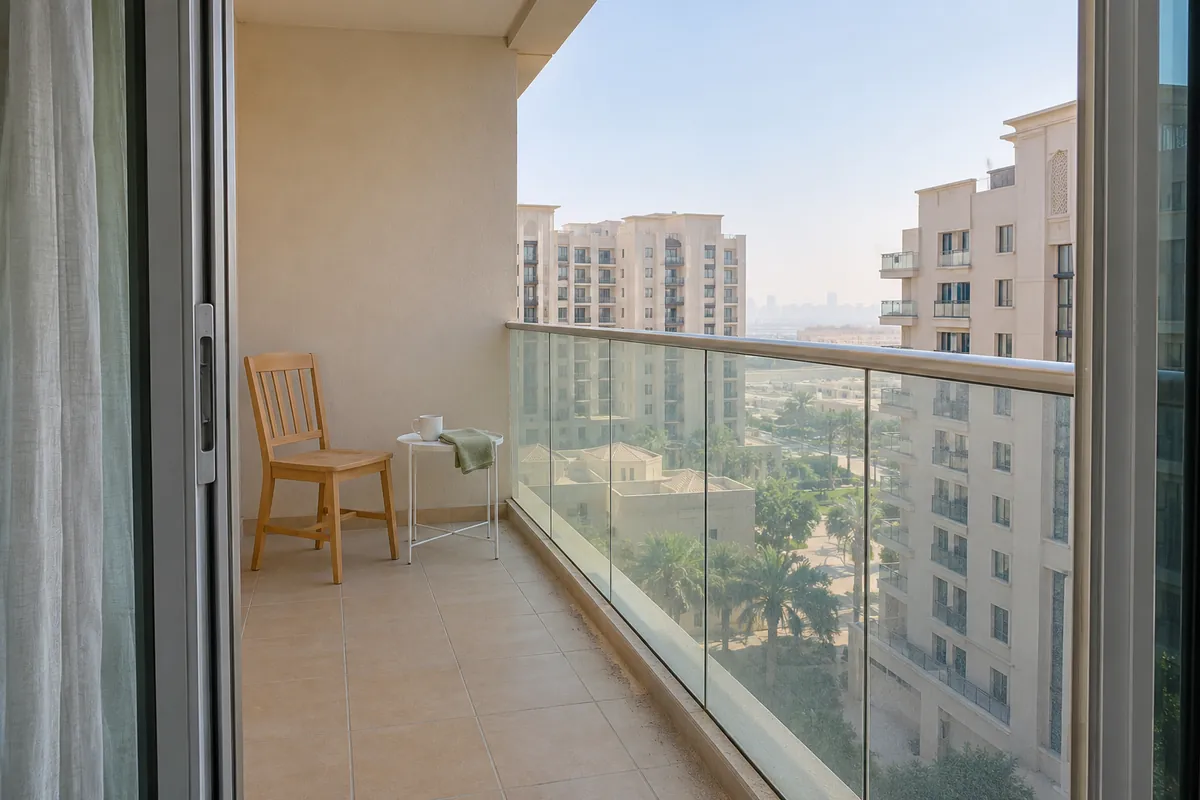
Start with the smallest activity the space needs to support. A morning coffee takes a seat and somewhere to put a cup. A narrow balcony can do that well even if it never has room for a dining set. Set the chair back from the railing, away from the route between the door and the seat, then use the balcony through a few ordinary mornings and evenings before committing to more furniture. The position that looks best from the living room may be the one where the next tower looks straight back.
Treat the doorway as part of the layout. A chair may fit when the glass door is shut and still make it awkward to step out with a tray or come back in carrying cushions. Leave the threshold and the drain accessible. If a balcony takes a full rearrangement every time somebody wants to sit down, it is worth taking an item away before buying anything else.
Seasonal use can be as simple as moving the same coffee outdoors at a different time of day. On days when conditions are poor, bring it back to the table inside the glass. Furniture that wipes clean and textiles that can come indoors make that switch easier than an arrangement built around permanent outdoor upholstery.
How can dust be managed without washing it over the edge?
There are two jobs: keeping airborne dust outside during an episode and dealing with what has already settled. The UAE’s National Air Quality Platform advises closing doors and windows at its higher air-quality risk levels. A fly screen should not be relied on in place of a closed door when that advice applies. Where there is time to prepare safely, bring loose items inside ahead of bad conditions rather than stepping out to retrieve them once the weather has turned.
For settled dust, look at the surfaces touched on the way out. The chair seat, tabletop and floor immediately outside the door matter more for everyday use than the far corner. Once conditions have eased, gather visible grit from accessible surfaces and wipe the table and seat with a damp cloth if the finish allows it. Keep the dirty water in a bucket or cloth rather than pushing it towards the edge. Where the building has a balcony washing procedure, follow it instead of assuming the drain is meant to carry cleaning water.
Dust that repeatedly returns at one point is worth noting. If grit keeps packing into the same part of the threshold, check the accessible track according to the door’s care instructions. If the door still will not close properly, or water pools after a clean-up, report the location to maintenance. Photograph the spot from within the balcony; there is no need to lean out or dismantle anything to show where the problem starts.
- Wait until local conditions have eased before stepping outside.
- Gather visible grit from the accessible floor and threshold.
- Wipe the seat and table if their finishes allow a damp cloth.
- Check that the door closes properly and the drain remains accessible.
- Report recurring pooling or a door that still fails to shut.
Where should insect control start?
Start on the balcony floor and at the door. Look for water left in pot saucers, a watering can or a bucket before adding equipment. The Centers for Disease Control and Prevention recommends using screens on windows and doors and checking water-holding containers once a week. Depending on the item, it advises emptying and scrubbing it, turning it over, covering it or throwing it out. A planter saucer tucked behind a chair is easy to miss, which is another reason to leave the floor accessible.
A screen at the doorway can help keep mosquitoes out of the apartment while the glass door is open and the screen is shut. It does not protect someone already sitting outdoors. That difference determines where effort is useful. If insects appear indoors after the balcony has been in use, look at how often the entry is left open. If the nuisance is at the seat itself, fitting the doorway alone leaves that problem where it was.
Water on a balcony floor after watering plants is a matter a resident may be able to resolve by adjusting the routine. Water that keeps appearing from a shared ledge, a leak or a drain problem calls for a report to management. Describe when it appears and whether it clears. That gives maintenance a better starting point than a request to treat the whole balcony for insects.
How can the balcony feel private without covering the railing?
Work out which view needs interrupting. A chair facing a building directly opposite presents a different problem from a chair exposed sideways to the next balcony. Try moving it towards a recessed corner or behind an existing side wall, if there is one. Check at seated height. Standing at the glass to assess the space can miss what is obvious as soon as someone sits down.
Then check what needs screening after dark. If the concern is the view into a lit living room, an existing indoor blind addresses that part of the problem without adding anything at the balcony edge. If the concern is the seat itself, an indoor blind does little for it. A seat on the wall side may still do more for privacy than a covering halfway up the railing, especially if the view comes from an apartment above.
If a visible outdoor barrier still seems necessary, describe it to management before buying it. A removable panel can still be visible from outside, and a loosely hung fabric covering is a poor choice on an exposed balcony. Ask whether there is a building-approved option and how it is meant to be secured. Until then, the useful test is whether a move of the seat makes the balcony comfortable enough without changing its outline.
- Across the courtyard: test the seat from the wall side of the balcony.
- From the next balcony: try a recessed corner and recheck the side view at seated height.
- Into the living room at night: check the existing indoor blind with the lights on.
- Still need an outdoor barrier? Ask about permitted placement and fixings first.
What should building management see before approving a fitting?
A request for permission is easier to answer when it shows the proposed change. Send a photo of the doorway or balcony edge from a safe position and mark where the fitting would go. Say whether the item would attach to the door frame, wall, ceiling or railing and whether any part would be visible from outside. Ask which building rule applies and whether there is a standard detail, a formal application or a no-objection certificate. Tenants should also check their lease and confirm with the owner which consent is needed before arranging work.
If management needs more detail, send the installer’s proposed mounting method rather than relying on a product photo. Dream Fly Screen Dubai makes custom retractable screens and says it can advise when a building requires a no-objection certificate or facilities management approval. That advice can help shape the request; the resident still needs to follow the property’s approval process before ordering the work.
Keep the written reply with the approved drawing or description. If the person fitting the screen arrives and proposes using a different surface, pause the job and check the change. Approval for a specific proposal is little help if the proposal has changed by installation day.
- Photo shows where the fitting would sit.
- Mounting surface and method are stated in writing.
- Visibility from outside is described.
- Building rules, required approvals and any owner consent are confirmed.
- Installer has the same description that was approved.
What if the building says no?
Ask what the refusal covers. If the issue is attachment to the railing, that does not answer whether a separate proposal at the doorway would be considered. If the problem is external visibility, ask whether there is a detail already allowed in the building. A clear refusal also saves the resident from buying something that will spend the year boxed in a cupboard.
Meanwhile, keep the changes that work without the proposed fitting. A chair moved back from the edge, a table that can be wiped before breakfast and empty saucers after watering all remain useful. For a balcony that is comfortable for part of a day, make that part easy to use. There is no need to turn the whole balcony into another room to make stepping outside worthwhile.
Frequently Asked Questions
Can a Dubai apartment balcony be used all year?
It can be useful in every season, even if it is off limits on individual days. The most practical setup is one a resident can open up quickly when conditions suit and bring back indoors when they do not.
Does a removable privacy panel need approval?
That depends on the building’s rules and the proposed panel. Ask before buying if it will be fixed or clipped to the railing or will change the balcony’s appearance from outside; removability alone does not settle those questions.
Who installs mosquito nets on balcony doors in Dubai?
Local fly-screen installers can supply door screens made to fit the opening. For an apartment, the useful first question is whether the installer can describe the mounting method in writing so the building can review it.
Is it enough to close the fly screen on a dusty day?
A fly screen is there to help exclude insects. When local air-quality guidance calls for doors and windows to be closed, shut the glass door rather than relying on the mesh.
Can balcony dust be rinsed into the drain?
Check the building’s washing instructions first, since those instructions apply to the particular balcony. For day-to-day cleaning, collect accessible grit and wipe surfaces instead of sending dirty water over the edge or assuming the drain is suitable for it.
What if the neighbouring balcony already has a panel?
An existing panel does not establish permission for another unit. Ask management whether it reflects a current approved building detail and whether that detail applies to the proposed location.
Where should furniture go if children use the balcony?
Keep chairs, tables and other climbable objects away from the railing. Abu Dhabi Police advises families to remove anything a child could use to climb balcony walls or railings. If the balcony is too narrow to keep a chair safely back from the edge, leave the chair indoors.
Sources
- Dubai Legislation Portal — Law No. (6) of 2019 Concerning Ownership of Jointly Owned Real Property in the Emirate of Dubai
- National Center of Meteorology — National Air Quality Platform
- Centers for Disease Control and Prevention — Preventing Mosquito Bites
- Abu Dhabi Police — ADP calls to monitor children to prevent falling accidents