Who Checks Balcony Fire Risks in English Flats?
The Direct Answer
The person or organisation that controls the relevant parts of a block of flats is responsible for assessing building fire risks, including those involving balconies. The Residents' guide to fire safety in blocks of flats, updated by the Ministry of Housing, Communities and Local Government on 18 November 2026, explains how the duty applies in England. A resident can ask how the balcony and external walls have been considered, but arranging the assessment and acting on its findings fall to the building’s legally responsible person.
Section 1 of the Fire Safety Act 2021 amended article 6 of the Regulatory Reform (Fire Safety) Order 2005. As the ministry’s factsheet explains, the scope includes the structure and external walls of buildings containing two or more sets of domestic premises, as well as the flat entrance doors between dwellings and common parts. The residents’ guide includes balconies when describing the elements covered. This matters even where a balcony is reached from inside a single flat: the resident may be the only person who normally sits there, while the way it forms part of the building remains a matter for the person with control of the premises.
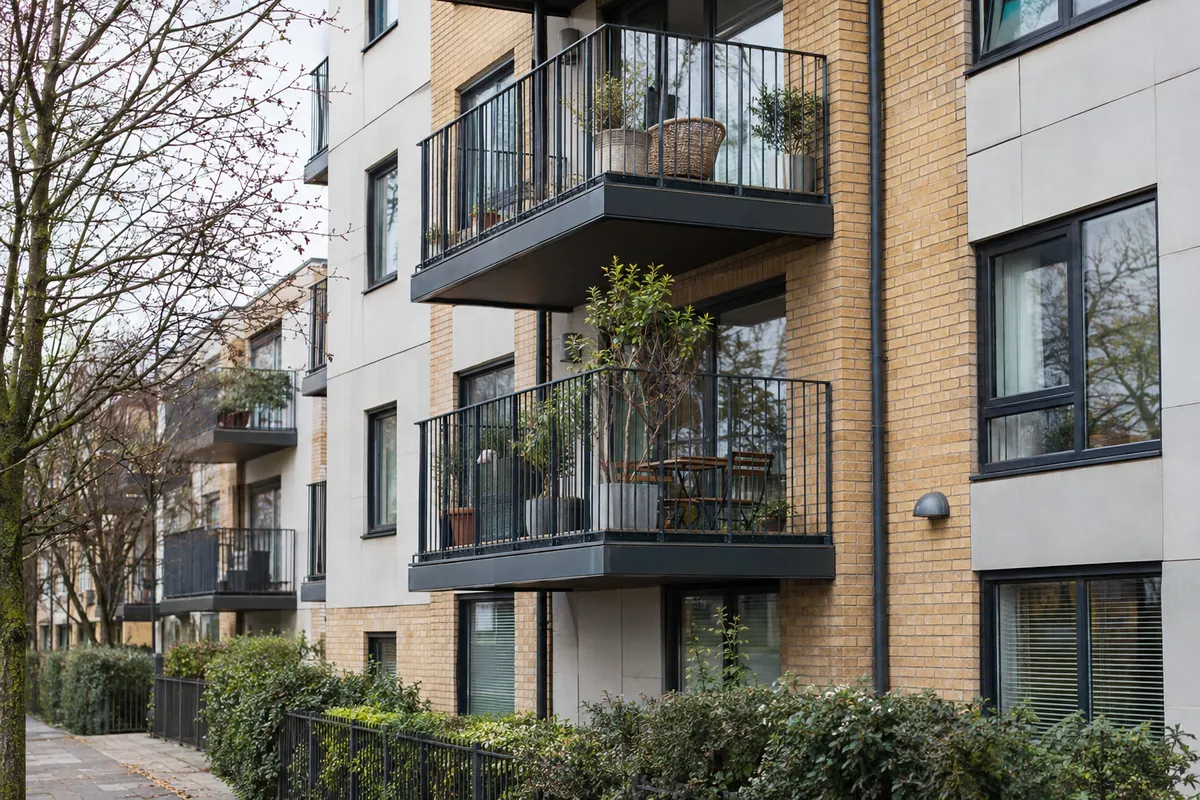
Who should answer a question about a particular balcony?
The ministry says the responsible person is usually a landlord, freeholder, managing agent or housing provider. The deciding point is who controls the relevant parts of the building. The person who collects rent or takes an everyday repair call may be able to route a question, but that alone does not identify who has the duty for the building structure. Fire safety information should include contact details for the responsible person or managing agent and explain how concerns can be reported.
In a block run by leaseholders, the answer can look different from an ordinary landlord arrangement. The ministry says a Right to Manage company is usually the responsible person for shared areas in buildings it manages. Where leaseholders collectively own the freehold, they may become the responsible person for communal parts, and in a commonhold the Commonhold Association manages the building and has fire and building safety duties. The name of the organisation that manages the block matters more to a resident seeking a reply than the general name of the tenure.
A first enquiry can be specific about scope: which part of the current assessment considers the balcony structure and its relationship to the external wall? It can also ask which contact will deal with a follow-up. That helps separate an answer about what a resident can keep on a balcony from the question of whether the building has assessed fire risks associated with the structure itself. One answer does not substitute for the other.
- Resident: Identify the location, report the concern and ask how it was assessed.
- Responsible person: Ensure the fire risk assessment is suitable and sufficient, arrange specialist appraisal where needed and act on risks.
- Building contact: Check the fire safety information for the responsible person or managing agent and the reporting route.
Which document answers which question?
A fire risk assessment, usually shortened to FRA, looks at hazards, the people at risk and the measures needed to manage those risks. The ministry says it should be suitable for the particular building, recorded and kept up to date. It should cover common parts and include flat entrance doors and external walls as relevant. A response confirming that an assessment exists is a useful start; the next point is what the assessment says about the area raised and what action, if any, followed.
A fire risk appraisal of external walls, or FRAEW, has a narrower job. It examines the risk of fire spreading through the external wall system, which can include cladding, insulation, cavity barriers, fixings and attachments. The ministry says a wider assessment may recommend that specialist appraisal if combustible materials are known or suspected in the walls, or if there is a material risk of external fire spread. An appraisal of that kind forms part of the overall assessment where there are concerns about the walls; it cannot answer unrelated questions about the rest of the building.
An appraisal is not automatically necessary for every block. The guidance gives low risk of external fire spread as a reason one may not be needed. If the building says no appraisal was required, a resident can ask what evidence supported that decision and when it was reviewed. If an appraisal did take place, the ministry suggests asking for its executive summary. That request can be paired with a plain-language question about the finding, any steps already taken and whether there is further work to do.
| Document | What it covers | Useful resident question |
|---|---|---|
| Fire risk assessment (FRA) | The building’s fire hazards, people at risk and measures to control risks | How did the assessment consider the balcony and external walls? |
| Fire risk appraisal of external walls (FRAEW) | Risk of fire spreading through the external wall system | Was a specialist appraisal needed, and what did it find? |
Who actually carries out an inspection?
The ministry’s Fire Safety Act factsheet distinguishes responsibility for making sure a risk assessment happens from the work of assessing the building. The responsible person can appoint someone to carry out the assessment on their behalf, such as a competent fire risk assessor. Where a more detailed external wall appraisal is needed, the factsheet says a competent person should be appointed for that work. A resident asking who looked at the building can therefore receive a different name from the one given for the responsible person, without any contradiction.
A follow-up may be more revealing if it separates the finding from the response. The factsheet says a detailed external wall appraisal should give the responsible person recommendations and an appropriate timescale, taking account of the work and any interim measures. A resident can ask which measures are in place now and which recommendations still need action. If the reply identifies a later review, asking when and how residents will hear the outcome is more useful than trying to interpret a photograph of the façade.
What should the building tell residents in plain language?
Under regulation 9 of the Fire Safety (England) Regulations 2022, responsible persons for multi-occupied residential buildings with two or more sets of domestic premises and common parts must provide fire safety instructions. The Home Office’s fact sheet explains that these cover how to report a fire and what residents should do under the building’s own evacuation strategy. It says instructions should be displayed in a conspicuous communal area, given to new residents and shared again at least annually and when updated.
The ministry’s residents’ guide also says the responsible person must provide clear information about risks identified in an assessment and how they are being managed. That is a different communication need from posting an evacuation notice. A notice tells an occupant what to do in a fire. An answer to a balcony enquiry should help an occupant understand how an identified risk is being dealt with. If a report contains technical detail, a short explanation tied to the specific building can be more useful to residents than being told only that documents are on file.
The evacuation instructions should come from the building rather than being inferred from its appearance or from a neighbour’s experience in another block. The ministry gives stay put and simultaneous evacuation as examples of strategies, not choices for a resident to make on the basis of an article. Where the posted instructions and the information sent to a flat appear to differ, the resident has a concrete question to put to the responsible person: which strategy is current, and when will the other copy be corrected?
What can a resident do if nobody answers?
An enquiry can distinguish what was observed from what remains unknown. Naming the balcony, elevation or connection to a shared part of the block gives the recipient something to identify. Specifying the document or decision sought gives them something to reply to. The resident need not make a judgement about the composition of hidden materials or inspect the wall system to raise a concern. A useful written record can simply identify the issue, the date it was reported and any reply received.
The ministry says residents who cannot get a response from their responsible person should contact their local authority to discuss next steps. The guide also lists routes by tenure: a private tenant can approach the council’s housing team or the local fire and rescue service; a social tenant can use the landlord’s complaints process and, if concerns remain unresolved, the Housing Ombudsman is among the options; a leaseholder can raise the issue with the freeholder or agent and then seek help from the council, local fire and rescue service or a leaseholder advice organisation. Those options concern unresolved building safety enquiries. They do not replace the building’s instructions for what to do in a fire.
- Who is the responsible person for the shared parts and structure?
- How does the latest fire risk assessment cover the balcony and external walls?
- Was an external wall appraisal needed, and is its executive summary available?
- What action has been taken since the assessment?
- Where are the current fire instructions for this block?
Frequently Asked Questions
Does sole use of a balcony make the resident responsible for assessing its structure?
The ministry treats balconies as part of the structure generally covered by the building’s fire safety responsibilities. The person or organisation with control of the relevant premises is responsible for the assessment, even where a resident alone normally uses the balcony.
Can a resident ask to see the latest assessment?
The ministry lists asking for the latest fire risk assessment as one question to put to the responsible person. It also says the responsible person must share information about fire risks identified in the assessment.
Does every building need an external wall appraisal?
A specialist appraisal may be needed where there are concerns about external fire spread or suspected combustible materials. The building’s assessment should explain the evidence for a decision that an appraisal is unnecessary.
Who can clarify which evacuation instructions apply?
The responsible person should provide clear instructions for the particular building. The ministry says residents should receive updates when fire safety arrangements change.
Where can a private tenant go after an unanswered report?
A tenant can first ask the landlord for fire safety information and report the concern. If it is not resolved, the ministry identifies the council’s housing team, the local fire and rescue service and tenant advice organisations as options.
Sources
- Ministry of Housing, Communities and Local Government — Residents' guide to fire safety in blocks of flats
- Ministry of Housing, Communities and Local Government — Fire Safety Act 2021 factsheet: Information on commencement of sections 1 and 3 of the Fire Safety Act
- Home Office — Fact sheet: Information to residents (regulation 9)